
Did you know that advanced age not only impacts female fertility but can also adversely affect men, causing male infertility problems? Studies reveal that as men age, there is a decline in both sperm count and sperm motility. This review also indicates that males over the age of 45 took a longer duration to assist their female partners in achieving pregnancy. Thus, ageing impacts not just the quality of a man’s sperm, but also decreases the likelihood of a successful conception. Does this imply that you should plan your fatherhood even if you are not fully prepared yet? Certainly not! Every problem has a solution to it. This is where Assisted Reproductive Technology (ART) and sperm banking come into play!
Intrigued? Let’s discuss sperm freezing and learn how it can aid ART techniques.
Sperm Banking In A Nutshell
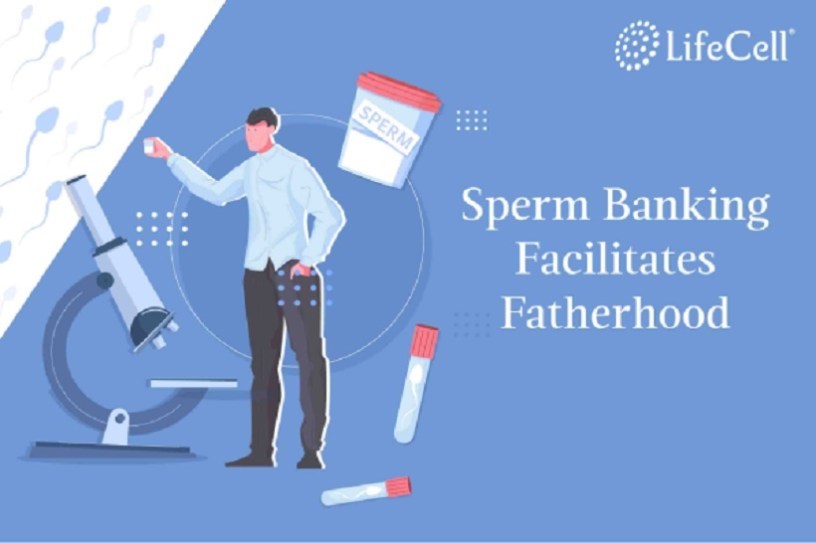
The procedure of freezing and preserving one’s sperm for later use is known as “sperm banking.” Men who want to undertake medical procedures such as cancer therapy, can consider sperm freezing. Additionally, those who choose to utilise ART, or wish to store their swimmers for potential future use are the ones who typically give sperm banking some thought.
The main steps in sperm banking include: –
- Examining the quality of the sperm
- Precisely cleaning and preparing the sample
- Freezing the healthy sperm
- Preserving the sample in cryo-vials at the research facilities
Assisted Reproduction Technologies: Know-How!
The term “Assisted Reproductive Technology” involves techniques like controlling the growth of sperm, eggs, and embryos. The underlying concept behind most of these treatments is to extract eggs surgically from the ovaries, couple them with sperm in a lab to develop an embryo (fertilisation), and subsequently return the newly formed embryo to the mother’s body.
All these processes may enhance the likelihood of a successful conception. On an individual basis, these therapies are advised.
Role Of Sperm Banking In ART Techniques
Although numerous factors contribute to the success of ART operations, sperm quality can be of significant importance. You can ensure this by preserving your sperm before undergoing an ART procedure. A fertility clinic can more easily obtain the necessary sperm at the time of treatment, thanks to sperm banking. And the sooner (younger) you opt to bank the sperm, the healthier it will be.
So, if family planning is not on your mind currently or you want to plan your baby later using assisted reproductive technologies, then go for sperm banking. Assisted Reproductive Technology (ART) techniques involve manually delivering the sperm to the female’s egg using methods such as intrauterine insemination (IUI), in vitro fertilisation (IVF), or intracytoplasmic sperm injection (ICSI).
For the best results, we advise you to keep up to 6 cryovials for each child based on LifeCell’s specialised formula. With this storage reasoning, you have 6 fertilisation chances and 2 appropriate treatment choices.
Let’s explore further the significance of sperm banking in all treatment options/ ART techniques.
In Vitro Fertilisation
This method includes extracting the eggs out of your partner’s ovaries and combining them in a lab with your sperm. The eggs or embryos are inserted inside the uterus during fertilisation, where the baby matures and is carried until term. Being proactive by preserving sperm allows you to choose fertility treatments like IVF when you are prepared to become a parent.
Intrauterine Insemination (IUI)
To increase the likelihood of pregnancy, healthy sperm are inserted directly into the uterus during ovulation. Under this process, the sperms are thawed and cleaned. Then, they are inserted into the female partner’s uterus beyond the cervix during ovulation.
Two important elements that affect how well this approach works are the quantity and quality of sperm. Also, the number of cryo-vials frozen will determine how many IUI attempts can be made. Storing a higher number of frozen sperm vials leaves room for more attempts with IUI.
Intracytoplasmic Sperm Injection (ICSI)
Due to advancements in assisted reproductive technologies such as Intracytoplasmic Sperm Injection (ICSI), fertilisation can now occur even with a small number of sperm. In this process, eggs from women’s ovaries are collected, similar to how it is done in vitro fertilisation (IVF). Nevertheless, the following stage deviates slightly from conventional fertilisation. This technique helps couples dealing with severe male infertility or those who were unsuccessful in fertilising during a previous IVF trial.
In ICSI, a single sperm is inserted into your female partner’s egg cell using a micropipette, from either a fresh or frozen sample. The resulting embryo is cultivated in the laboratory for 1 to 5 days. After that, it is implanted into the woman’s uterus for continued development.
Summing Up
Many factors can impact male reproductive health. Checking your fertility status and exploring options to preserve fertility is crucial in achieving your reproductive goals. Conveniently monitor your fertility with at-home tests like SpermScore for prompt semen analysis.
Furthermore, these tests can help determine the optimal moment to preserve your sperm when they are in good condition for future usage. The samples can help you conceive when you are prepared to start a family. Thanks to advancements in assisted reproductive technologies such as IVF, IUI, and ICSI, as well as sperm banking services like SpermVault, you can still pursue starting a family whenever you choose.
Product Recommendations:
- SpermScore
- SpermVault
- InferGenes
Also Read:
- Age and delayed parenthood
- Cancer therapy and Chronic medical conditions
References:
- https://www.ncbi.nlm.nih.gov/pmc/articles/PMC3253726/
- https://www.ncbi.nlm.nih.gov/pmc/articles/PMC3854059/
- http://hopkinsmedicine.org/health/treatment-tests-and-therapies/sperm-banking
- https://my.clevelandclinic.org/health/treatments/17493-sperm-banking
- https://www.ncbi.nlm.nih.gov/books/NBK576409/
- https://medlineplus.gov/assistedreproductivetechnology.html
- https://www.nichd.nih.gov/health/topics/infertility/conditioninfo/treatments/art#
- https://www.cancer.gov/publications/dictionaries/cancer-terms/def/in-vitro-fertilization
- https://www.hfea.gov.uk/treatments/explore-all-treatments/intracytoplasmic-sperm-injection-icsi/
- https://www.sciencedirect.com/topics/medicine-and-dentistry/intrauterine-insemination
- https://www.ucsfhealth.org/education/faq-intracytoplasmic-sperm-injection#4
- https://medlineplus.gov/ency/anatomyvideos/000074.htm
 Tips & advice for living healthiest life